


1
free
Activation Engine
What should I do this week with one creator signal?
Seven-day plan, product route, MCP plan, assistant prompt, and community handoff.
Yes. GenCreator has major potential, but the center of gravity should be scalable digital product first, community second, and 1:1 Studio judgment only after proof exists.
Brand specimen
Vector-first, product-ready
GenCreator
Creator intelligence OS
Create
Signal to packet
Activate
Packet to week
Practice
Proof to community
The product must answer the first buyer question without a call: what do I make, install, practice, or buy this week?
MCP gives GenCreator a portable language for tools, resources, prompts, and approvals across assistants and workbenches.
GenCreator.community should start from artifacts, proof loops, and source pulse rituals so the system gets better through practice.
Personal help becomes more valuable when it reviews real work from the self-serve system, not vague ambition.
Brand assets
The mark is a generator loop with a center rail and approval arrow. It has to hold at favicon size, app icon size, product-card size, and partner-doc size.

Navigation, app surfaces, product cards, export covers, and small-size proof.
Open assetHigh-contrast surfaces, favicons, partner decks, invoices, and print-safe exports.
Open assetPartner docs, media kits, delivery rooms, product receipts, and community onboarding.
Open assetInspectable vector sheet for the creation, activation, MCP, community, approval, and Studio primitives.
Open assetInspectable vector layout reference for carousel, vertical video, OG, newsletter, and wide product-proof frames.
Open assetProduction route for logo rules, type decisions, social formats, carousel systems, motion frames, GTM plays, and assistant prompts.
Open assetAssistant-readable JSON and markdown contract for social media, video, motion, and brand production.
Open assetLive UI mark and lockup shared by navigation, hero badges, and product pages.
Open assetHuman-readable brand, product, software, community, and service-boundary system.
Open assetAssistant-readable JSON contract for brand assets, tokens, icon primitives, product ladder, and MCP software layer.
Open assetPortable strategy and brand contract for collaborators, agents, and future product packaging.
Open assetIcon language
These primitives are simple line icons derived from the same logic as the mark: input, rail, loop, route, and approval. They work in UI, docs, delivery rooms, and community rituals.
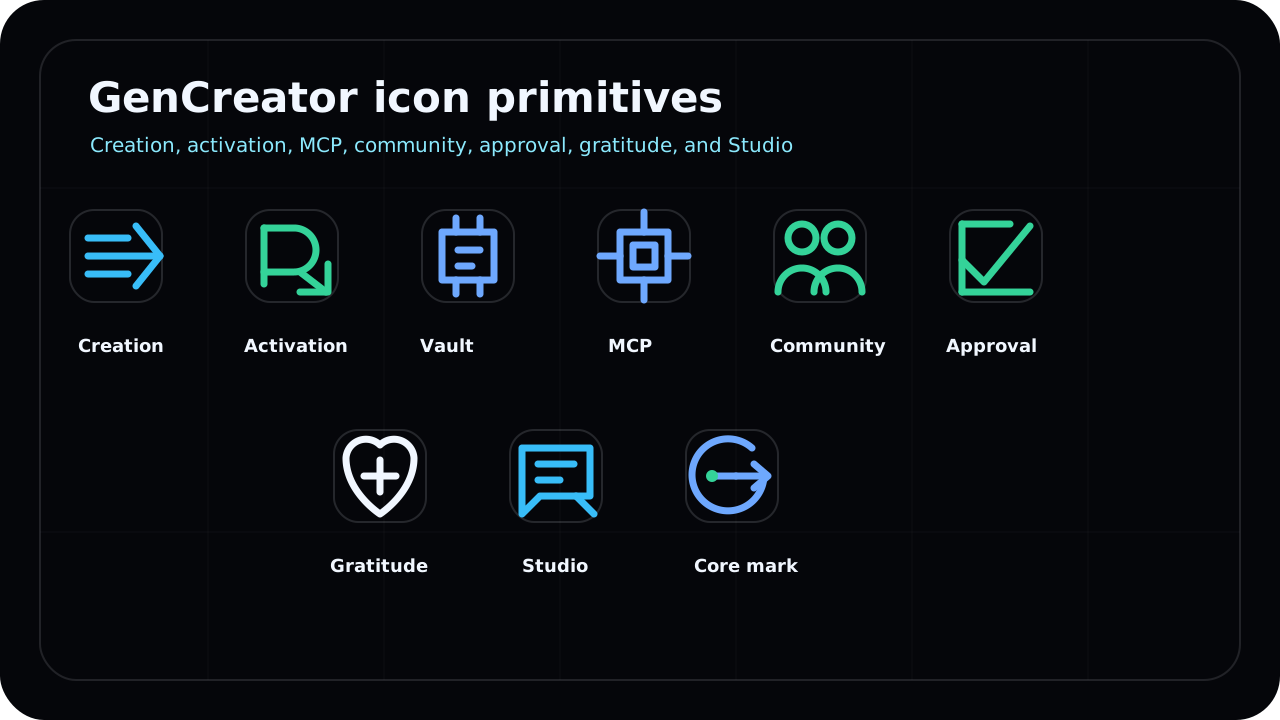
One signal becomes a usable artifact with proof, draft, and route.
The artifact becomes seven days of operating behavior.
Voice, audience, proof, offers, and policy become reusable memory.
Tools, resources, prompts, and permissions make the OS portable.
Finished artifacts enter review, ritual, example, and memory.
Drafts stay drafts until a person approves the public action.
Sources, collaborators, customers, and teachers stay visible.
Direct review enters after the self-serve system creates proof.
Color and material
Blue is architecture, cyan is signal, green is approval. The palette avoids warm courseware and generic purple SaaS haze.
#05060A
Primary background and premium command surface.
#0A0C14
Stable panels, app shells, and product proof sections.
#101522
Interactive glass cards and docked tool areas.
#1A1F2E
Subtle separation without decorative outlines.
#F1F7FF
Primary text, mark contrast, and document exports.
#275EFE
Systems thinking, structure, and MCP routes.
#6EA8FE
Navigation states, secondary highlights, and proof chips.
#38BDF8
Outlier radar, creation flow, and active intelligence.
#34D399
Human approval, community proof, and safe completion.
#8BE9FD
Premium edges, specular glass, and hero highlights.
Primary mark strokes, CTA glow, and product flow state.
Premium liquid-glass cards, delivery rooms, and app controls.
Hero atmospheres that show system depth without becoming decorative haze.
Approval bars, timeline connectors, and checkout success states.
Business architecture
The business works when every buyer knows the next artifact, the delivery format, the support boundary, and the route into community or Studio.
free
What should I do this week with one creator signal?
Seven-day plan, product route, MCP plan, assistant prompt, and community handoff.
free
What should I learn, install, practice, buy, or escalate next?
Learning modules, skill packs, MCP resources, product handoff, community bridge, and Studio boundary.
self serve
Can this idea become an installable digital product?
Modules, prompts, MCP resources, checkout handoff, and activation rhythm.
paid
Which artifact solves my current bottleneck fastest?
Vault Kit, Campaign Pack System, and Agent and MCP Pack with clear support boundaries.
community
Where does the work get practiced and sharpened?
Weekly proof loop, source pulse, review request format, and member artifact library.
studio
When do I need direct judgment instead of more material?
Private review, offer critique, campaign judgment, and agent workflow design.
Software spine
The strongest version is a general-intelligence workbench for creator businesses: portable workflows, governed tools, memory, approvals, and a community practice loop.
GenCreator should be usable inside the assistants creators already trust, with tools, resources, prompts, and modes.
Read-only, draft-only, and approval-required modes; no external posting in v1.
Inspect layerThe product becomes useful when a creator can install a workflow into their own assistant and produce one artifact.
Skills teach behavior and draft artifacts; they do not claim private implementation support.
Inspect layerGenCreator becomes easier to buy when a creator can see the right module, skill pack, MCP resource, community bridge, and Studio boundary from one state.
The path recommends product and practice routes; it does not replace proof, member entitlement checks, or direct review.
Inspect layerSelf-serve product becomes more valuable when voice, offer, proof, source credit, approval, MCP resources, and community review live in one operating state.
Browser-local and deterministic until authenticated member vault persistence and entitlement checks are wired.
Inspect layerRoles, prompts, MCP config, and approval policy make the system more valuable than a static prompt file.
Agents draft, inspect, and prepare review records; humans approve public actions.
Inspect layerEve is the future operator, but starts as a deterministic brief generator until memory and entitlements are stable.
No autonomous publishing, charging, deleting, messaging, or external writes.
Inspect layerCreators need one place where signal, plan, assistant prompt, checkout handoff, and community review stay connected.
Browser-local today; member vault persistence belongs behind auth and entitlement checks.
Inspect layerThe sales system must state what is bought, what is delivered, what is blocked, and what support is not included.
Provider products and gated paid bundles remain explicit blockers until wired.
Inspect layerGenCreator.community
Community turns the product into a weekly practice: source pulse, build block, review thread, Friday proof, and digest. The point is not passive access. The point is a repeated culture of building with taste, evidence, gratitude, and approval.
No passive entry: bring one artifact, one question, and one proof metric.
Source pulse: name the source material and the proof that would change the plan.
Build block: create one artifact from the vault, campaign, skill, agent, or approval layer.
Review thread: ask for one decision, not broad feedback.
Friday proof: share what changed, what shipped, and what remains constrained.
Digest: return the best example to the member artifact library.
Service boundaries
The first business priority is a product that creates value without a call.
Includes
Does not include
The community turns artifacts into rhythm, taste, accountability, and better examples.
Includes
Does not include
1:1 help stays premium and scarce, reserved for creators with proof and pressure.
Includes
Does not include
Assistant prompts
These prompts turn the brand into product decisions, MCP design, community handoff, and Studio gating.
Open JSON contractUse when deciding what GenCreator should build or sell next.
Turn this creator problem into a scalable GenCreator product. Name the buyer, first artifact, delivery format, support boundary, activation plan, MCP resource, community proof loop, and paid upgrade.
Use before adding tools or agent features.
Audit this workflow for MCP fit. List which parts should be resources, tools, prompts, approval-required actions, and local-only instructions. State what must not be automated.
Use when moving a creator from product output into community.
Turn this finished artifact into a GenCreator.community review request. Include the artifact, one decision question, proof metric, source credit, and next seven-day action.
Use before routing a creator into Studio.
Decide whether this creator needs Studio or another self-serve loop. Check proof, revenue or audience pressure, campaign clarity, agent readiness, and what direct judgment would change.